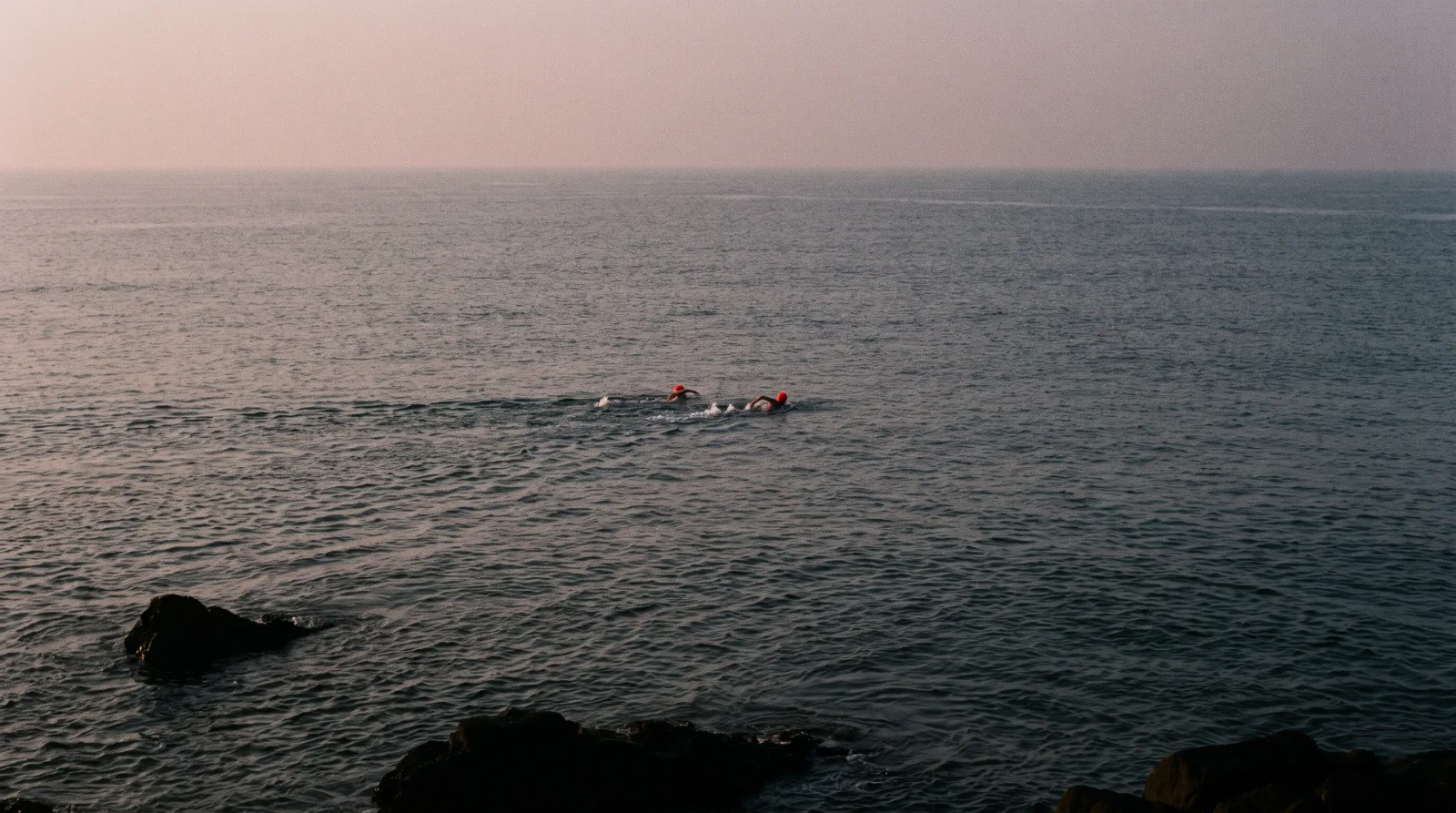
You can swim sixty lengths without stopping. You get in the sea at Marve and you are breathing like you sprinted up a stairwell after two hundred metres. Nothing has gone wrong with your fitness. You have simply met five variables the pool removed for you, all at once.
Here is what actually changes, in the order it will hit you, and what to do about each one.
1. You cannot see the black line, so you cannot swim straight
In a pool the lane does the navigating. In the sea you do, and the first time you look up you will find you have drifted thirty degrees off course. Swum badly, a 1500 metre course becomes 1750 metres, and you paid for every extra stroke.
The fix is sighting, and it is a skill you can practise indoors before you ever get salt in your mouth. Every six to eight strokes, push slightly harder on the catch, lift the eyes just clear of the surface, take one flat look forward, then roll straight into your breath to the side. Eyes up, then breathe. Never eyes up and breathe, because lifting the whole head drops your hips and you will feel like you are swimming uphill.
Practise it in the pool with your eyes closed for six strokes and a sight on the seventh. It feels ridiculous. It is the single highest-value thing a first-timer can drill.
2. Chop does not care about your beautiful catch
A textbook stroke assumes flat water. The sea off Mumbai in the morning is rarely flat, and a swell that looks like nothing from the sand will interrupt your breathing every fourth stroke. Two adjustments:
- Shorten and quicken slightly. A long, glide-heavy stroke stalls in chop. Raise your cadence a little and accept a shorter reach.
- Learn to breathe both sides. Not for symmetry. For the day the swell is coming from your right and you physically cannot get air on that side.
3. Salt water floats you, and it also dries you out
You will sit higher than you do in a pool, which is a small free gift. You will also swallow some, and your throat will be raw afterwards. Rinse your mouth with fresh water as soon as you are out, and expect the first few sessions to leave you thirstier than the distance justifies.
4. The start is a contact sport
Two hundred people swimming over the same line, and for the first ninety seconds somebody will hit your foot, your hip or your goggles. The panic this causes has almost nothing to do with swimming and everything to do with surprise.
You defuse it by rehearsing it. Train in a group, deliberately swim close, let people touch your feet, get used to somebody crossing in front of you. Once it is familiar it is annoying rather than frightening, and annoying you can swim through.
On race day, if you do not love the contact, start at the back and to one side. You will lose a few seconds and save yourself a few minutes.
5. Cold, or in Mumbai, warm
Most open water advice is written for cold water. Here the problem is usually the opposite: warm water means no wetsuit, so no free buoyancy and no free speed, and an easier time overheating on the swim than you would expect. Check the race rules for whether wetsuits are legal at the expected water temperature, and train in what you will race in. Discovering on race morning that your wetsuit is banned is a bad way to start a day.
6. You will be slower than your pool pace, and that is correct
Expect your first open water hundreds to come in well outside your pool splits. Sighting costs time. Chop costs time. Not being able to push off a wall every twenty five metres costs a surprising amount of time. This is not a fitness problem, so do not train it as one.
How to build up to it
A sensible ramp for somebody who is comfortable in a pool and new to the sea:
- Weeks one to two, pool only. Add sighting drills to every swim. Two sessions a week, nothing heroic.
- Weeks three to four, first sea sessions. Short, parallel to the shore, inside your depth, always with other people. Twenty minutes is a full session.
- Weeks five to six, add group starts. Practise the scrum. Add a continuous swim at your target race distance.
- Week seven onward, race rehearsal. Same time of day, same kit, same breakfast, same warm-up as the race.
Never swim open water alone. Go with a group, swim where there is supervision, wear a bright cap and use a tow float. This is not caution for its own sake. Currents near the Mumbai coast change quickly, and a tow float is the difference between being visible to a boat and not.
The part that actually matters
Almost nobody fails an Ironman swim because they were not fit enough. They have a bad ninety seconds at the start, their breathing goes, and the next twenty minutes are spent recovering from a panic instead of swimming. Every item on this page exists to make the first ninety seconds boring.
Get those ninety seconds boring, and the swim becomes what it actually is: the shortest leg of the day, and the one you will miss when it is over.